You're running AI in production. Your team is building forecasts, generating reports, making recommendations: all powered by models you can't verify. You trust the output because it sounds confident. Because it moves fast. Because everyone else is doing it.
That's the gap.
You've spent decades building verification into every critical system: financial controls, quality assurance, code reviews. But with AI, you're abandoning all of it. You're accepting outputs as truth without audit trails, without provenance, without accountability.
This isn't innovation. It's negligence.
The execution gap in AI-driven leadership isn't a technical problem. It's a discipline problem. Organizations are deploying capability without building the verification systems that justify the trust. And when the output is wrong: when the forecast misses, when the diagnosis fails, when the recommendation tanks: leaders discover they own the decision anyway.
The Trust Trap
AI outputs sound authoritative. They look clean. They arrive fast. That polish creates a dangerous assumption: the model must be right.
But authority isn't accuracy. A 2025 transparency index scored leading AI developers at 37 out of 100 on disclosure metrics. The industry has prioritized capability over verification. Speed over integrity.
Your team is using these tools to make decisions that carry real risk. Financial projections. Hiring recommendations. Resource allocation. Customer segmentation. And most leaders can't answer basic questions:
- What data trained this model?
- What assumptions are baked into the logic?
- How do we verify the output before we act on it?
- Who owns the decision if the model is wrong?
You don't know. So you trust. And trust without verification is just hope with a dashboard.
Why Verification Lags Behind Adoption
Leaders move fast on AI because the pressure to adopt is relentless. Competitors are shipping. Boards are asking questions. Teams are demanding tools.
So you deploy. You integrate. You operationalize. And you skip the step that would normally be mandatory: verification.
This is a cultural failure, not a technical one. You have rigorous controls everywhere else:
- Financial reporting requires audits, reconciliation, and sign-offs.
- Software development requires testing, code review, and version control.
- Clinical decisions require peer review, evidence standards, and accountability.
But with AI, you're throwing all that rigor out the window. Why?
Because verification slows you down. Because the tools don't make it easy. Because you assume the model is smarter than your team.
None of those are reasons. They're excuses.
The Verification Framework: Trust But Verify
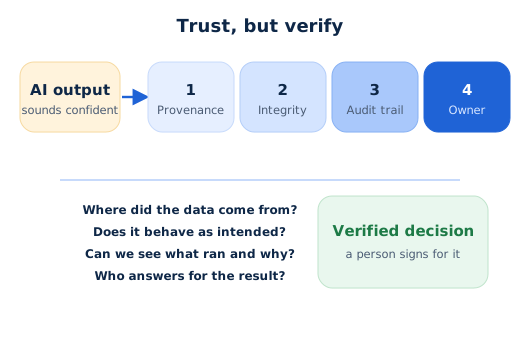
Closing the execution gap requires reinstating the discipline you abandoned. Trust but verify isn't a slogan. It's an operating system.
Here's what verification looks like in practice:
1. Data Provenance
Trace every input. Know what data trained the model. Know what data is feeding the inference. If you can't document the source, you can't trust the output.
Action: Require data lineage documentation for every AI system in production. No exceptions.
2. Model Integrity
Verify that the model behaves as intended. Test edge cases. Audit for bias. Validate assumptions. Just because a model works in aggregate doesn't mean it works in your context.
Action: Build a testing protocol for AI outputs before they inform decisions. Treat model validation like you treat software QA.
3. Audit Trails
Document every inference. What went in. What came out. Who acted on it. When the model is wrong, you need to know why: and you need to know fast.
Action: Implement append-only logs for all AI-generated outputs. Make the trail visible and permanent.
4. Human Accountability
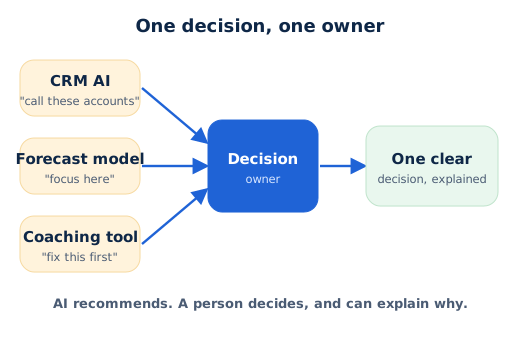
AI doesn't make decisions. Leaders do. When you present an AI-generated forecast to the board, you're not asking them to trust the model. You're asking them to trust your judgment.
Action: Own the output. If you can't defend the reasoning, don't ship the recommendation.
The Leadership Reality: You Own Every Output
Here's what most leaders miss: stakeholders don't care about the AI. They care about you.
When the forecast is wrong, they're not blaming the model. They're blaming the executive who trusted it without verification. When the hiring recommendation fails, the board isn't questioning the algorithm. They're questioning your judgment.
The competitive advantage won't come from deploying AI faster. It will come from deploying verifiable AI: and proving through rigorous validation that the outputs are trustworthy.
That means:
- Building verification into your workflow, not bolting it on later.
- Rejecting outputs you can't defend, even if the model sounds confident.
- Treating AI decisions like any other critical decision: with rigor, accountability, and discipline.
This is where most organizations fail. They treat AI as a productivity tool when it's actually a decision-making system. Productivity tools can fail quietly. Decision-making systems can't.
What to Do Now
If you're running AI in production without verification systems, here's your execution checklist:
Week 1: Audit Your AI Stack
- Document every AI system influencing decisions.
- Identify which outputs lack verification protocols.
- Flag high-risk systems (financial, clinical, operational).
Week 2: Build Verification Protocols
- Establish data provenance requirements.
- Create testing and validation processes for model outputs.
- Implement audit trail documentation.
Week 3: Enforce Accountability
- Assign ownership for every AI-driven decision.
- Train leaders to verify outputs before acting.
- Reject recommendations that can't be defended.
Week 4: Measure and Iterate
- Track verification compliance across teams.
- Document failures and refine protocols.
- Make verification non-negotiable.
This isn't optional. If you're deploying AI without verification, you're not innovating. You're gambling with decisions you'll be held accountable for.
Close the Gap or Own the Failure
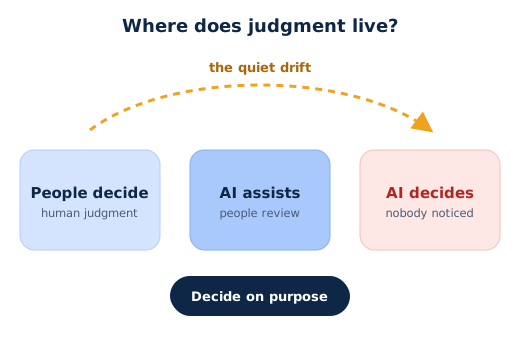
The execution gap exists because leaders trusted speed over discipline. They assumed AI accuracy without demanding proof. They outsourced judgment to systems they can't verify.
That ends now.
Verification isn't a barrier to AI adoption. It's the foundation. The leaders who win won't be the ones who deploy fastest. They'll be the ones who deploy with integrity: who can prove their AI outputs are trustworthy because they built the systems to verify them.
You already know how to do this. You have verification protocols everywhere else in your business. Apply the same rigor to AI. Demand provenance. Enforce accountability. Own every output.
Strategic Execution isn't about moving fast. It's about moving with certainty.
This is part 3 of the Ungoverned Judgment series. Read Part 1: Is Your Judgment Migrating? and Part 2: Why Your Strategy Fails as AI Complexity Rises.
Ready to Execute?
If you are leading through AI complexity and want help standardizing verification and enforcing decision integrity, let's talk. Start with one conversation about where AI already touches your decisions and what has to be verified before anyone relies on it.